21
Sep 26
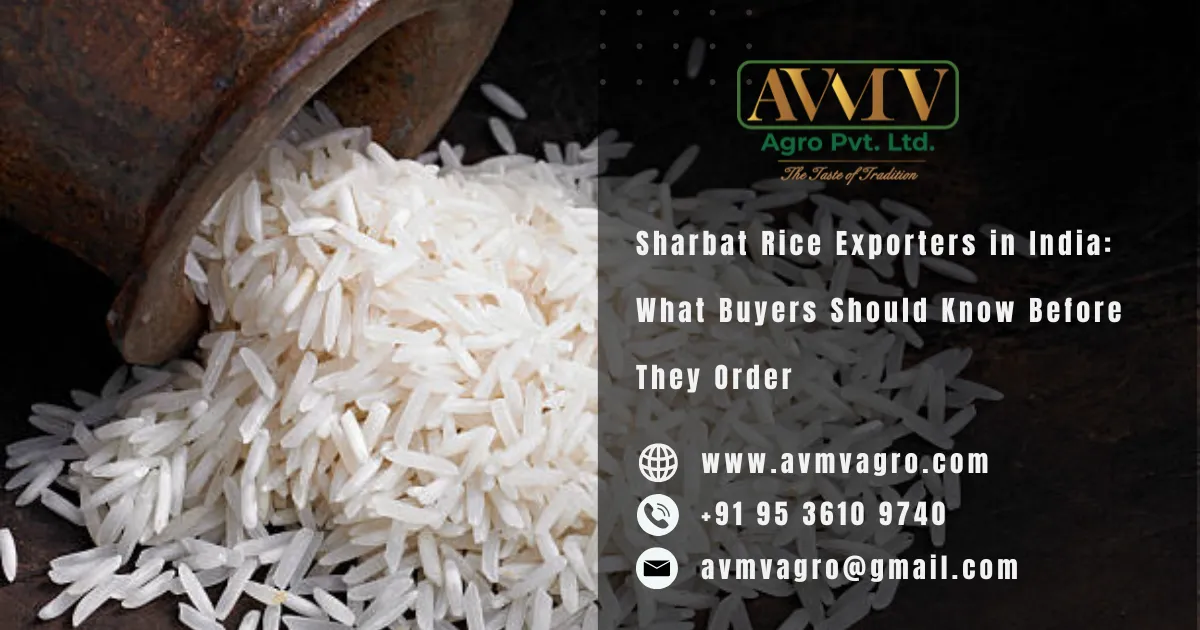
Sharbat Rice Exporters in India: What Buyers Should Know Before They Order
Sharbat rice doesn't get the same attention as 1121 or Pusa Basmati, but it has a loyal following among buyers who want a lighter, softer aromatic rice without paying premium Basmati prices. If you're comparing Sharbat Rice Exporters in India, there are a few things worth checking before you commit to a container.
What Is Sharbat Rice, and Why Do Buyers Ask For It
Sharbat is a non-Basmati aromatic variety, shorter in grain length than 1121 or Pusa but still noticeably fragrant when cooked. It's popular in regions where buyers want that Basmati-style aroma for everyday meals rather than special-occasion cooking — think restaurants doing high-volume biryani or households that go through rice quickly and don't want to pay Basmati rates for it.
The grain cooks softer than true Basmati and doesn't elongate to the same degree, which is exactly why some buyers prefer it. It suits dishes where you want the rice to absorb flavour rather than stand apart on the plate.
What to Check Before Choosing an Exporter
Grain Consistency and Sorting
Sharbat rice varies more from mill to mill than Basmati does, mostly because it's processed at higher volumes and lower margins. Ask for a sample batch before placing a bulk order, and check for uniform grain size and colour. A mix of long and short grains in the same bag usually means the sorting line wasn't run carefully.
Moisture and Storage Conditions
Because Sharbat is often moved in larger volumes, moisture control matters more than buyers expect. Rice stored above safe moisture levels is prone to mould and weight loss in transit. A reliable exporter will share recent moisture test results without being asked twice, and will explain how the rice was stored before loading — silo, warehouse, humidity control, all of it.
Export Documentation
Confirm the exporter handles phytosanitary certification, fumigation records, and APEDA registration directly, rather than outsourcing it to a third party you have no contact with. If something goes wrong with paperwork mid-shipment, you want to be dealing with the mill, not chasing a broker who's since moved on to the next order.
How Sharbat Compares to Other Varieties Buyers Consider
Buyers rarely order Sharbat in isolation — it usually comes up alongside a few other varieties while comparing suppliers.
PR 11 Rice Exporters in India cover a similar budget-conscious segment, though PR 11 is a non-aromatic variety aimed more at bulk domestic supply than export aroma appeal. It's worth asking whether your exporter handles both, since that tells you something about their milling range.
If aroma and grain length matter more than price, an 1121 Sella Basmati Rice Manufacturer in India is the usual upgrade path. Sella (parboiled) 1121 holds its shape well in bulk cooking, which makes it a common step-up choice for buyers who started with Sharbat and later want something firmer for catering or export.
Parmal Rice Manufacturer in India listings come up too, mostly for buyers stocking a mixed order — Parmal is a plain, non-aromatic table rice, and having it alongside Sharbat in one shipment can cut down on separate supplier relationships.
For something between Sharbat and full Basmati in terms of aroma, Sugandha Rice Exporters in India are worth a look. Sugandha has a stronger scent than Sharbat and a longer grain, sitting at a mid-range price point that suits buyers who've outgrown Sharbat but aren't ready for Basmati costs.
A Sona Masoori Raw Rice Manufacturer in India is a different category altogether — short-grain, not aromatic in the same way, and popular in South Indian markets specifically. If your buyer base spans regions, it's worth checking whether one exporter can supply both Sharbat and Sona Masoori rather than splitting the order.
And for buyers scaling up from Sella 1121 toward international markets, confirming the supplier also works as an 1121 Sella Basmati Rice Exporter in India — not just a domestic manufacturer — saves the hassle of switching suppliers later when export volume picks up.
Why AVMV Agro
AVMV Agro Private Limited processes and exports a range of rice varieties, including Sharbat, Sella, and raw Basmati, from its India-based facility. Buyers can request grain samples, moisture reports, and export documentation directly rather than going through layers of intermediaries — which matters most when you're trying to lock in consistent quality across repeat orders.
FAQ
Is Sharbat rice the same as Basmati?
No. Sharbat is a shorter-grain aromatic variety, cheaper than Basmati and with a softer cooked texture. It's often chosen as a more affordable alternative for everyday cooking or high-volume catering.
What moisture level should Sharbat rice have for export?
Most exporters aim to keep moisture around 12–13% to avoid spoilage risk during transit. Ask your supplier for a recent test report rather than taking the figure on trust.
Can I order Sharbat and Basmati varieties from the same exporter?
Yes, in most cases. Many exporters, AVMV Agro included, handle both aromatic and non-aromatic varieties from the same facility, which simplifies logistics for buyers ordering a mixed container.
How do I know if a Sharbat rice sample is good quality?
Check for uniform grain size, minimal broken grains, and a clean, slightly earthy aroma. Avoid samples with visible discolouration or a musty smell, which usually points to storage issues.
Conclusion
Sharbat rice fills a real gap between budget non-aromatic varieties and full Basmati, and the right exporter makes that gap easy to work with. Check grain consistency, moisture reports, and export documentation before committing, and give some thought to whether you'll eventually want to add Sella, Sugandha, or Sona Masoori to the same order. AVMV Agro supplies across that range from one facility, which is worth considering if you're planning to scale the relationship rather than place a single trial order.